When Confidence Becomes Arrogance
How can we express what we’re good at without appearing egotistical?
Many highly-skilled individuals are reluctant to express openly what they know they’re really good at. Even when they understand they’re talented at something, they hold back or downplay their knowledge. There are a lot of reasons people find this difficult. They may wonder:
“Am I being egotistical or arrogant if I say I'm good at that?”
“Am I really an expert on this subject?”
“Aren't there a lot of people that can do this better than me?”
I work with many clients on being authentically self-expressed, learning to convey their good qualities easily, and speaking clearly about the things they have proficiency in. I myself would much rather be the expert in the background writing the copy, generating the script, or doing the coding rather than being the presenter or speaker exposed to the crowd.
Pay no attention to that man behind the curtain!
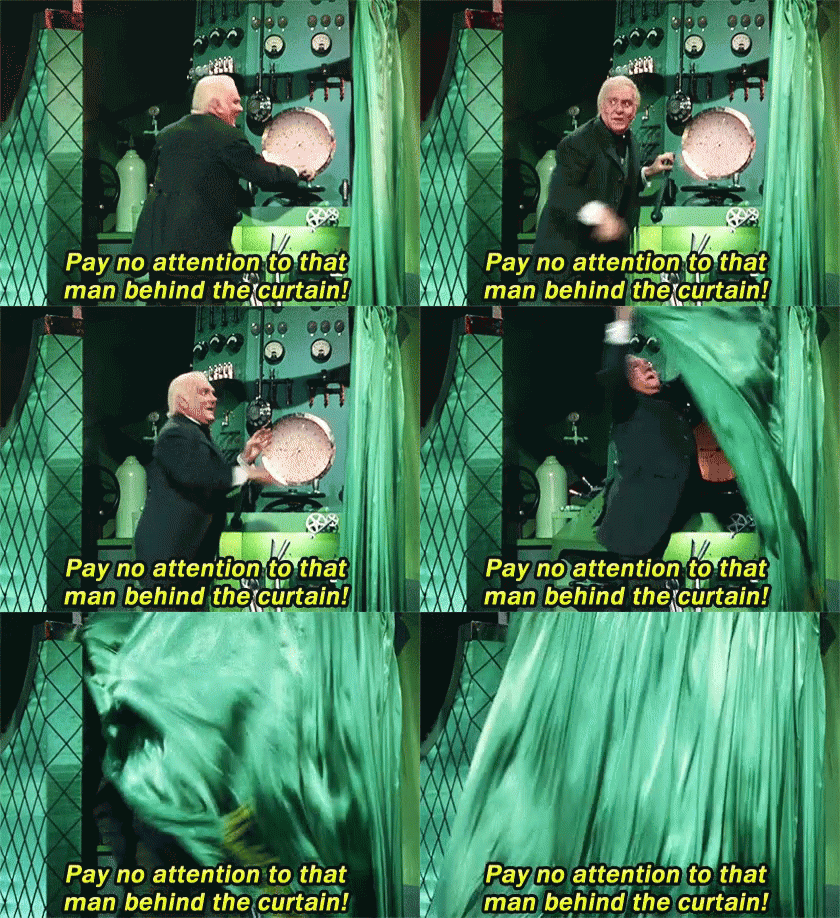
These days, it’s not so easy to hide behind the curtain and still achieve the success we’re looking for. It's more important than ever that we get clear on what we're best at and what expertise and skills we offer to the world. If we want a job, for example, we’ll need to be able to talk about our skills and achievements in an authentic way. And the increasingly common jobs in the “gig economy” require you to clearly spell out our areas of talent and our level of aptitude.
If you want to be recognized as a leader, you need to be able to tell people why you should be seen as the expert or leader by letting them know about your achievements and skills in your particular area of expertise.
The bottom line is that you got trained so you could use your knowledge, and your skills will simply go to waste if not recognized or used. If you want to be an asset to your colleagues and to your company, you’ll need to learn to speak up about how you can contribute.
What is it that gets in the way of a genuine expression of our capabilities?
There’s a subtle conflict that arises because many of us were "trained" through cultural or religious traditions to be humble and to not brag about ourselves. This can get in the way of proper recognition for the things we're actually really proficient at. If we are downplaying our skills or hiding in the background, it may feel honorable, but it won't help us to advance in the world to get the success we desire.

How to HumbleBrag
One technique some use to overcome this is to appear to be humble while actually bragging. This is called the humblebrag and you want to avoid this at all costs! Please!
You also need to know about the Dunning-Kruger effect that says that the more someone knows about a topic, the less confident they are in their skill level. One of the ways this shows up for highly-skilled individuals is that they honestly don't know how talented they are in the subject area. It seems that the more you know, the more you realize how much there is to know about a particular topic, so the less you feel you actually know. We often don't have a reference point or another person to compare ourselves to, so it's really difficult to declare expertise.
We might think, “Since I'm obviously not an expert, what will happen if I claim to be talented and then a real expert comes along and challenges my knowledge?” Potentially embarrassing for me!
The problem with this is there's always someone that knows more about a topic than you out there and we need to stop hiding our talents.
The other problem exposed by Dunning-Kruger is people who are low aptitude have a higher confidence level in their abilities than those who have real expertise in the subject matter. That means there are lots of people out there who simply don't know as much as they think they do! If I’m an expert, then I can see this and I judge them and definitely do not want to be one of them, so I won’t call myself an expert until I’m absolutely sure I know everything!
In the end, all of this comes down to one thing: fear of criticism or fear of rejection. We're afraid that if we say we're clever at something, we'll be called arrogant or egotistical or our knowledge will be questioned by someone who knows more than us and we'll be humiliated.
Fear of criticism is a deep form of self-protection shared by most every human being
How can we compensate for these fears? We want to be skilled and have expertise at things and let people know and be able to use our knowledge. Where do we draw the line between genuinely expressing that we are proficient on a topic vs. being (or appearing to be) arrogant, egotistical, or boastful?
This is extremely subjective, and that means no matter how humbly you express yourself, someone somewhere is going to call it bragging or arrogance.
The key lies in your intention and in the commitment you have to using your expertise and talents to help others. When you are authentically trying to be a useful resource for others by offering your talents, it is not arrogance or bragging. What’s important is to get clear on your intention and to learn how to express that in a way that isn’t off-putting to others.
If you are being authentic and your intentions are in the right place, then it is much easier to manage the perception of arrogance because you don’t have to step into the story that you yourself are actually arrogant. The only thing to manage is how you are expressing yourself.
For example, there was a very smart guy in my engineering school who went for a job interview before graduating. The interviewer asked him what he knew about topic X. This very smart guy said, "Nothing right now, but in a year, I'll know more than you."
Giving this guy the benefit of the doubt, his intention may have been simply to express that he was a quick learner and that would make him a valuable resource because of this aptitude for learning. Regardless, this came across to the interviewer as outstandingly arrogant. He didn't get the job.
The point is that egotism and arrogance are in the eye of the beholder, but it helps to understand what most beholders would consider arrogant self-expression.
How can I help?
There’s an exercise I have my clients do that helps get them over their fear of saying they’re good at something by getting them used to saying it. I ask them to write down 5 things they’re are skilled at and to do this at least three times within a week.
Try this exercise for yourself right now. Write down 5 things you are talented or skilled at.
Here are mine:
I'm very good at and have a lot of experience in Life Coaching
I have deep knowledge, experience, and skill around all things computer and software related, specifically disk drive technology (my old career!)
I'm a good writer
I'm a good speaker
I'm a good photographer
What most people do around this is to use a lot of qualifiers: "pretty good" "kind of" "I guess" "people think" "people have told me". It’s a way of trying to “soften” it so that people won’t think they’re bragging, but it undermines the quality of what you’re trying to communicate.
Don't do that. "I'm good at X" is all you need.
Get used to saying things this way. Do it every day. Write it down. Say it to yourself.
And don’t brag.
Be humble and also let people know what you’re good and skilled at
It's all subjective. Don't undermine your success by qualifying your good qualities!
How do I know I'm not being egotistical?
If you are asking yourself that question, you most likely are not being an showoff and simply need to understand how to communicate in a comfortable and authentic way about your abilities.
I’ve heard it said, the way you know you're not a narcissist is that you are honestly and sincerely asking the question of whether you are a narcissist.
Can you ask yourself that question sincerely and really reflect on that?
Then you’re not one. You’re welcome.
And remember…
Photo by Melanie Hughes on Unsplash