Noticing How We Notice: Why Second-Order Learning Changes Everything
“The range of what we think and do is limited by what we fail to notice. And because we fail to notice that we fail to notice, there is little we can do to change until we notice how failing to notice shapes our thoughts and deeds.”
Most training or development programmes teach us to do new things—learn a new skill, delegate better, prioritise better. This is all helpful, but it remains in the realm of doing without exploring the underlying context and way of being that gets in the way of our becoming truly effective.
Second-order learning invites us to replace the assignments and to-do lists with deeper awareness and observation of our way of being. It asks us to examine how we are seeing, not merely what we are doing, and to redesign the invisible habits of language, emotion, and embodiment that generate our perceptions in the first place.
From First Order to Second Order
First-order learning operates inside our current frame of reference: Behaviour → Results → Repeat. We add a new skill, polish a familiar routine, and chase incremental improvement. This is a necessary part of our personal and professional development.
Second-order learning is about becoming a better observer of ourselves. Instead of just trying to change our actions, we look at how we see the world—our inner “observer”—which is shaped by our deeper way of being. By shifting this, we naturally shift our actions and the results that follow. Way of Being → Observer → Behaviour → Results.
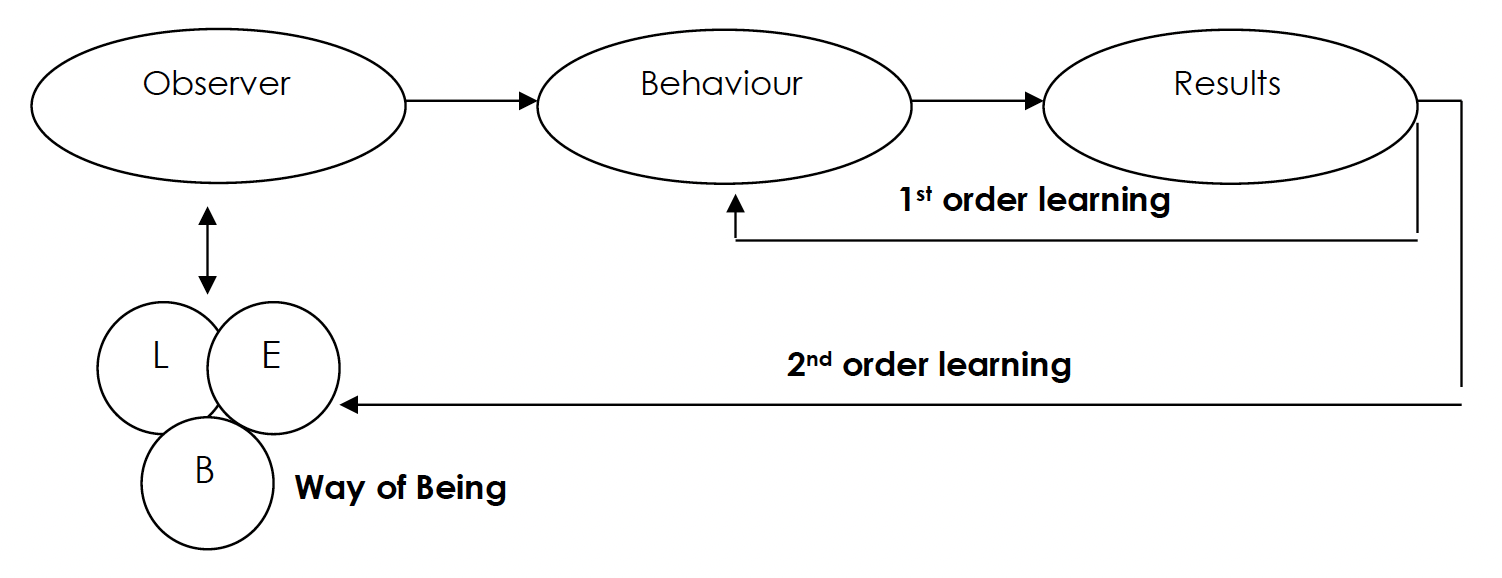
Why does this matter? Because “problems, possibilities, and solutions are a function of how we are observing”. When our observing shifts, fresh opportunities that were literally invisible the day before come into view.
The Only World We Know Is the One We Observe
A core premise of Ontological Coaching is that “the only world we know is the world we observe”. Our observation is not a camera feed; it is an interpretive act shaped by three mutually-reinforcing domains:
Language – We observe through our distinctions, assessments, and narratives. Label an early release a failure, and you close doors; call it a prototype, and curiosity ignites.
Emotions – Moods predispose us to notice and act in certain ways. Resignation obscures options that ambition suddenly reveals.
Body – Our Way of Being “is embodied”; hunched shoulders and shallow breath literally shrink what seems possible.
Because these domains interact, a shift in any one can trigger a systemic shift in the rest. Change the story, and posture relaxes; open the chest, and mood brightens; transform the mood, and new language becomes available.
“Until you make the unconscious conscious, it will direct your life, and you will call it fate.”
Noticing How We Notice — Deepening the Practice
We “cannot change what we aren’t aware of,” so second-order learning starts by making the act of observing itself observable. Second-order learning begins the moment we turn our attention back on the act of attention itself.
Below are some richer “how-to” steps you can weave straight into coaching sessions or personal reflection. Each step names a simple action, explains why it matters, and offers a prompt or micro-move to try on the spot.
Pause & Center
What to do: Interrupt autopilot for 30 seconds—feel both feet, lengthen the spine, let the next exhale last twice as long as the inhale.
Why it matters: A centred nervous system widens perceptual bandwidth; without physiological safety, the mind defaults to threat-scanning.
Try this: “Where is my weight? Can I let the chair or the floor hold me?”Surface the Language
What to do: Catch the exact sentence running your thinking—no editing. Decide if it’s an assertion (fact) or an assessment (opinion).
Why it matters: Language is the quickest doorway to the Observer; naming the sentence externalises it.
Try this: “I notice the thought ‘We’re behind again.’ Is that data or judgement?”Name the Mood
What to do: Label the felt tone with one word—impatient, curious, resigned, etc.—then ask what action this mood is predisposed to take or avoid.
Why it matters: Moods are action backgrounds; identifying them reveals the hidden behavioural script.
Try this: “In this mood of urgency, I tend to push and skip dialogue.”Scan the Body
What to do: Track tension, temperature, and micro-postures. Shift one element—drop the shoulders, soften the jaw, open the chest—then notice the ripple in thought and feeling.
Why it matters: The body is the most immediate lever for altering Way of Being; physiology and meaning-making co-evolve.
Try this: “When I broaden my stance, does a different interpretation appear?”Ask a Meta-Question
What to do: Turn curiosity on the whole noticing system.
Why it matters: Meta-questions unhook you from content and position you as the designer of the lens itself.
Try this: “What is this pattern trying to protect or preserve? What possibilities am I excluding by holding this story?”Choose & Commit
What to do: Select one alternative speech act, mood, or somatic shape that would better serve your larger commitment. Declare it, embody it, and live from it for the next hour.
Why it matters: Choice completes the loop—awareness without action becomes an intellectual cul-de-sac.
Try this: “I choose the mood of openness and will ask one exploratory question in the next meeting.”
Common Pitfalls to Watch For
Analysis Paralysis – Getting lost in mental dissection without anchoring in the body. Re-center every 90 seconds.
Story-Swapping – Replacing one ungrounded assessment with another. Always test: data or opinion? grounded or speculative?
Mood Shaming – Judging certain feelings as “unprofessional.” Remember: every mood contains intelligence; the aim is discernment, not suppression.
Building the Muscle Over Time
Micro-journaling: End each day with three quick lines—Narrative / Mood / Body note. Patterns pop within a week.
Language Buddy: Pair with a colleague to flag each other’s favourite assessments and request clearer speech acts.
Somatic Anchors: Tie a physical cue (hand on abdomen, shoulder roll) to the meta-question “How am I noticing right now?” to create an in-the-moment reset.
Practised regularly, this six-step loop turns “noticing how you notice” into a leadership reflex—an embodied stance of curiosity that keeps expanding what is possible long after any particular framework fades.
By noticing what we notice, we become better observers of ourselves and become the authors of our experience instead of passengers in it.
A Leadership Vignette
Maria, a product VP, works 70-hour weeks. Time-management hacks (classic first-order fixes) barely dent the load. In coaching, she discovers an unspoken narrative: “If I’m not busy, I’m dispensable.” The story shows up in rapid-fire speech (language), low-level anxiety (emotion), and tight shoulders (body).
By observing the pattern rather than fighting the symptoms, Maria experiments with an upright stance, slower breathing and a new declaration: “My value multiplies when I enable others.” Within a month delegation rises, hours drop and her team steps into greater ownership. Nothing about the external situation changed; the observer did.
Coaching and Organisational Impact
Ontological coaches “work in the territories of first-order and second-order learning”. They help clients tinker with behaviour and renovate the underlying architecture. In organisational life, this dual focus pays three dividends:
Better Problem-Framing – Teams stop recycling blame and start asking, “How are we looking at this issue?”
Expanded Possibility Space – New narratives, moods, and postures turn stalemates into solvable puzzles.
Sustainable Change – Because Way of Being shifts, improvements persist beyond the coaching engagement.
Bringing Second-Order Learning to Your Culture
Make Language Visible—Introduce shared distinctions such as assertion (fact) versus assessment (opinion). Meetings will become clearer and less personal.
Normalise Mood Talk – Begin check-ins with “Which mood best describes you right now?” Naming emotions defuses their covert power.
Integrate Somatic Practices – Short breathing or centring exercises before high-stakes conversations ground collective presence.
Small, repeated moves at the level of Way of Being compound into a culture where noticing how we notice is standard operating procedure.
Conclusion
Second-order learning reminds us that the biggest lever for transformation is rarely another best practice; it is the quality of the observer applying the practice. When we attend to our language, emotions, and embodied stance, we do more than fix problems—we invent worlds in which those problems dissolve.
So the invitation is this: pause today, notice how you notice, and choose a Way of Being that enlarges what is possible—for you, for those you lead, and for the future you are here to create.