Learning to Walk Again
What 130 kilometers on a bad ankle taught me about the third option nobody offers you
The doctor was adamant: "I would never get surgery on that ankle."
He was the third opinion. The first two had come from the surgery clinic. After an MRI and an X-ray, they told me I needed a special kind of surgical procedure. When you have a hammer, everything looks like a nail. Surgeons tend to see through the lens of surgery, and I was not up for that.
Two years of pain and trouble with my left ankle had brought me here. And in a few weeks I was supposed to walk 130 km.
The Walk
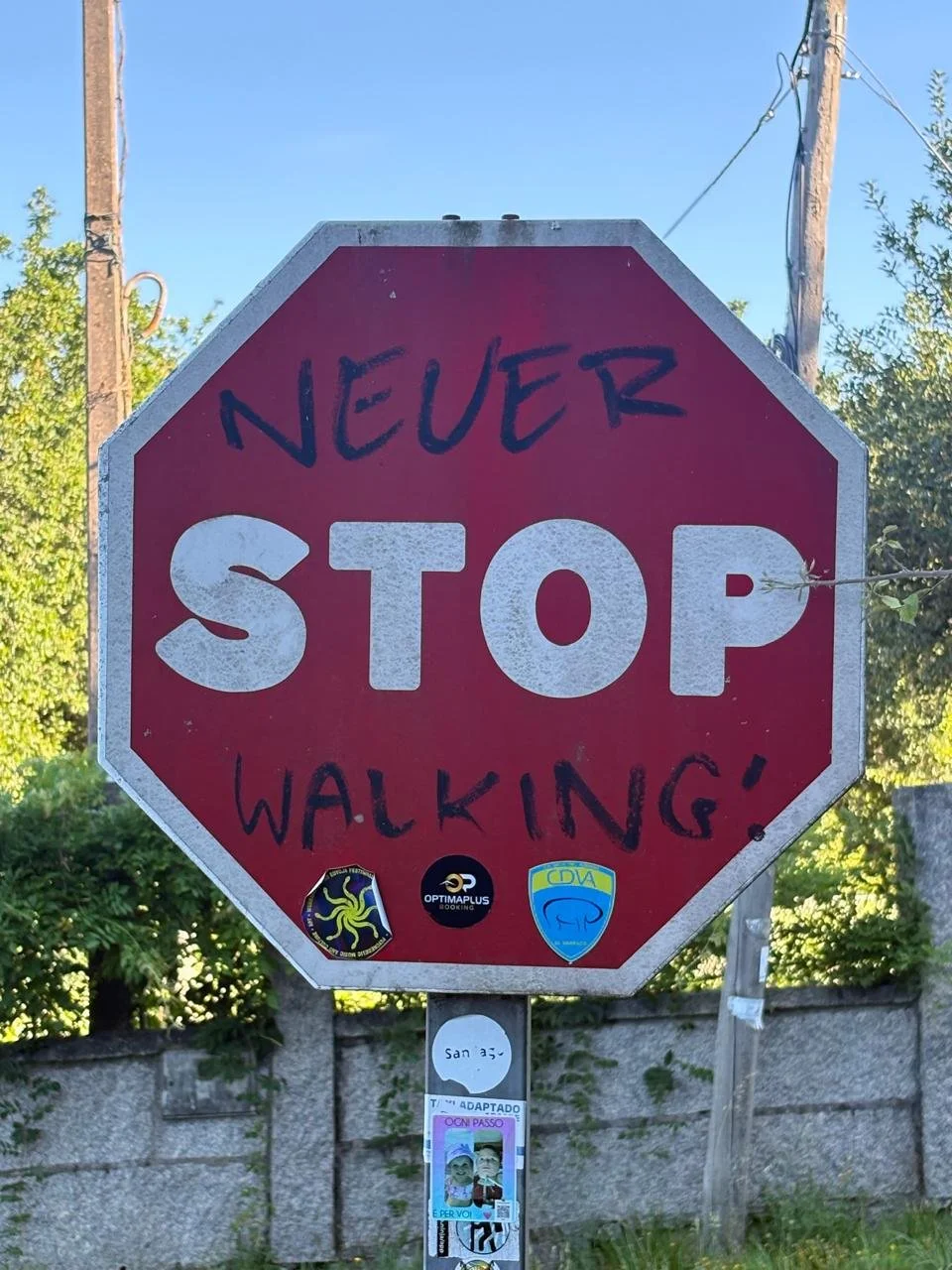
Seen on the Camino. Good advice, though not quite the lesson I got.
I recently finished the Camino de Santiago, walking with a group of friends for eight days and 130 km. Most days were 18, 19, or 20 km, and our longest stretch was 25 km. There was a heat wave, so we were usually out of the hostel by 6 am to get the distance behind us before the hottest part of the day.
Twenty kilometers a day with a 9 kg pack was not a given. I was genuinely unsure I would finish given the issues with my ankle.
I don't remember when the ankle trouble started, but I know it became acute on a day hiking in Appenzell with my wife. The pain got so bad I had to stop and rest. That was the moment I decided to get help.
After the surgeons offered their opinion, I waited. It was late winter, the pain was manageable, and I told them I would go about my spring outdoor activities and see how things went. That held up until we booked the Camino and my fitness acquired a deadline. Everything was fine except the ankle. After a few training walks up to 14 km, the pain got worse, and a friend recommended a physiotherapist.
That appointment at the sports medicine clinic was a different kind of conversation: more curious and holistic. The diagnosis was instability in my gait, caused by weak muscles in the lower leg. This was not a structure to be cut and repaired, but a way of moving that had gone wrong over time and could be retrained. The clinic’s doctor consulted at the end, and he was the one who was adamant.
I fit in three sessions before we left. Exercises to strengthen the walking muscles, and something else: retraining my brain about how the foot moves while walking.
Learning to Walk Again
Everything about walking the Camino was new to me. And on the first day, I realized it was not going to be about simply walking. I was teaching myself to walk differently. Learning to walk again, like a baby stepping out on two feet for the first time.
The spiritual orientation of my whole walk was revealed in those first few kilometers: returning to simplicity, and to not knowing.
Physically it meant:
being deliberate about lifting my feet off the ground more
lifting the front of my foot as I moved it forward
lifting the back of my foot as I moved it backward
exaggerating the movement of walking, to reprogram my brain
keeping my posture upright and poised
This took effort and concentration.
I had plenty of concentration, thanks to the Camino. For eight days my only task was to walk to the next stop, so nearly all of my attention went into the next step. Which is the only place it was ever available to be spent.
What the Pain was for
At some point every single day, my ankle would start to hurt.
And every single time, in the moment of noticing the pain, I became aware of something else: I had stopped walking the way I had been practicing. I had drifted back into my old gait without knowing it. The pain was not telling me to stop. It was telling me I had wandered off.
So I would return to the practice. Lift the feet. Front of the foot, back of the foot. Posture upright. Within a minute or two, the pain would fade. Sometimes it went away entirely for a long while.
I have lived in this body for a long time, and I thought I understood my relationship to pain. The arrangement was simple: something hurts, you stop doing the thing, the hurting stops. That is the whole contract. I had never once had the experience of changing how I was doing something and having the pain quietly withdraw while I kept going.
My theory is that shifting my gait recruited different muscles and gave the tired ones a rest. It is probably right.
Still…
Neither
How I respond to pain has changed over the years. There are times to push through it, as in my marathon training, and times to rest, ice, and rehabilitate, like when I tore my calf muscle.
Do I need to push through this?
Do I need to rest and recover before I go on?
Used to be, those were the only two questions I knew how to ask. A coach friend of mine says, “A rest day is a training day.” He’s right, and knowing which day you are in is most of the skill in sustaining high performance over a long career.
On the Camino, the answer was neither.
I did not push through the pain, and I did not stop. I renewed my practice while still moving, and the pain left.
That is a third option, and it had never been on my list.
The first two questions are about effort. How much, or how little. The third one is about something else entirely: not how hard I am going, but the way I am going. Not the load, but the manner of carrying it.
It is worth being clear about what that costs. A repair is something done to you, once. What I have instead is a practice. The gait work and the strength exercises are permanent features of my life now, and there is no version of this where I am finished and can stop paying attention.
I notice I am fine with that. Better than fine.
The question
Most of us have something that aches on a predictable schedule. The 3 am waking. The heaviness that arrives on Sunday evening. The colleague who produces the same flash of irritation in the same spot, every time, like a stone in the same shoe.
And most of us have only the two questions. Push through it, or back off and recover.
There is a third question, and it is less comfortable, because it doesn’t let us put the problem entirely outside ourselves:
What does my way of moving have to do with this?
Not how hard I am working. Not how much rest I need. How I am going about it, and what I have drifted away from without noticing.
That is a different contract than the one most of us signed. The old one reads the ache as a verdict: stop, or endure. The new one reads it as information, and what it usually reports is drift.
So the ache might not be telling you to stop at all. It might be telling you it is time to learn to walk again.
Please note: I am describing my ankle, not yours. Get the second opinion, and take your own instincts seriously as data.